MUSA: Cancun's Underwater Sculpture Museum
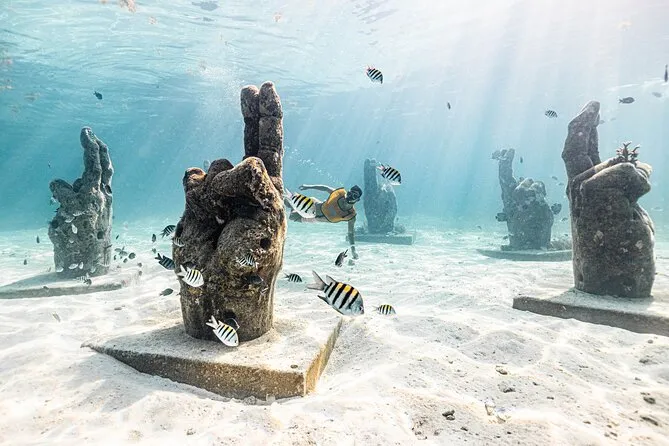
MUSA Cancun, the Museo Subacuático de Arte, is a museum you swim over: more than 500 life-size sculptures planted on the seabed between Cancun and Isla Mujeres, slowly turning into reef. It opened in November 2010 as a way to pull visitor pressure off the natural coral of the Cancun marine park, and today it splits into two galleries with very different rules about who can visit and how. This page explains what is actually down there, the difference between Salon Manchones and Salon Nizuc, and whether to see it by snorkel, scuba or glass-bottom boat.
Quick answer
MUSA is an underwater museum of 500+ sculptures by Jason deCaires Taylor and collaborating artists, installed in the Cancun marine park from 2009 and opened on November 26, 2010. It has two galleries: Salon Manchones, about 8 meters deep off Isla Mujeres, open to divers and snorkelers, and Salon Nizuc, about 4 meters deep off Punta Nizuc, reserved for snorkelers and glass-bottom boats. There is no ticket booth; you visit with a licensed operator, and the marine park fee rides along with the trip.
Key takeaways
- Two galleries: Salon Manchones (about 8 m, snorkel or dive, off Isla Mujeres) and Salon Nizuc (about 4 m, snorkel-only, off Punta Nizuc)
- The 5-in-1 snorkel trip that includes the MUSA statues runs $79 for 7 hours with reef, shipwreck and cenote stops
- You cannot swim out on your own; access is by licensed boat only, and glass-bottom trips at Punta Nizuc cost about $58 USD if you want to stay dry (checked August 2026)
- The sculptures are made of pH-neutral cement designed to grow coral; touching them is prohibited, and regular sunscreen is banned in the marine park
- Many of the statues were cast from real people in the fishing town whose reef we cover on the Puerto Morelos page
Cancun Snorkeling Tours That Put You Over the Statues
These are the trips from our comparison that include MUSA or the Manchones area in the water time, not just a boat pass-by. Prices and reviews are pulled from the operators' live Viator listings.
from $79
5-in-1 Cancun Snorkeling: Turtles, Reef, MUSA, Shipwreck & Cenote
The most comprehensive Cancun snorkeling tour in one full day: swim with sea turtles, drift over a coral reef, dive around MUSA underwater museum statues, explore a sunken…
- 5 snorkel spots in one day
- MUSA underwater museum
- Swim with sea turtles
- Cenote + shipwreck included
 from $79
Reef & Shipwreck Snorkeling: Turtles, Cenote & Hotel Pickup
Three of Cancun's best snorkel experiences in one tour: swim alongside sea turtles at their feeding ground, drift over a sunken shipwreck, and snorkel inside a freshwater cenote…
- Sea turtles at feeding ground
- Sunken shipwreck snorkel
- Freshwater cenote included
- Hotel pickup included
 from $55
Isla Mujeres Luxury Sailing & Snorkeling (Adults Only or Family)
Sail on a luxury catamaran to Isla Mujeres, snorkel the Caribbean reef off the island's coast, then relax with an open bar and beach time before sailing back…
- Luxury catamaran to Isla Mujeres
- Snorkeling off the island reef
- Open bar on board
- Adults-only & family options
What MUSA Actually Is
A Museum Built to Save a Reef
MUSA stands for Museo Subacuático de Arte, the Underwater Museum of Art. The Cancun marine park is one of the most visited stretches of water in the world, receiving roughly 750,000 to 800,000 visitors a year, and by the late 2000s that traffic was wearing the natural coral down. Dr. Jaime González Cano, then the local head of Mexico's environment secretariat SEMARNAT, wanted a way to ease pressure on the reef without closing the park.
His answer was to build a second attraction: he brought in the British sculptor Jason deCaires Taylor, and with the Cancun and Isla Mujeres nautical associations they began sinking sculptures in 2009. The museum formally opened to the public on November 26, 2010, and boats have been splitting their passengers between statues and natural reef ever since.
MUSA at a Glance
Numbers below come from the museum's own materials and the sculptor's project records, checked August 2026.
| Detail | MUSA |
|---|---|
| Full name | Museo Subacuático de Arte |
| Opened | November 26, 2010 (first sculptures placed 2009) |
| Sculptures | More than 500 permanent life-size works |
| Main artist | Jason deCaires Taylor, with later Mexican collaborators |
| Galleries | Salon Manchones (about 8 m) and Salon Nizuc (about 4 m) |
| Footprint | Over 420 square meters of previously barren seabed |
| Material | pH-neutral marine cement that encourages coral growth |
| Access | Licensed boats only: snorkel, dive or glass-bottom |
The word museum is not marketing. The sculptures were commissioned by the national marine park and the Cancun Nautical Association, the site is monitored by researchers, and the collection was planned to grow toward 12 galleries and around 1,364 artificial habitats over time. The works sit downstream of the natural reefs on purpose, so coral larvae drifting off the reef after spawning have clean cement to settle on.
Salon Manchones vs. Salon Nizuc: The Two Galleries
Everything about planning a MUSA visit comes down to which gallery your boat goes to, because the two sit in different parts of the bay and take different kinds of visitors.
| Salon Manchones | Salon Nizuc | |
|---|---|---|
| Location | Off Isla Mujeres, near Manchones Reef | Off Punta Nizuc, south end of the Hotel Zone |
| Depth | About 8 meters | About 4 meters |
| Who can visit | Scuba divers and snorkelers | Snorkelers and glass-bottom boats only; no scuba |
| What it holds | The largest works, including The Silent Evolution | Smaller, shallower installations easy to see from the surface |
| Typical trip | Dive boats and Isla Mujeres catamarans | Jungle-boat and snorkel tours from the Hotel Zone |
Which Gallery Should You Pick?
Snorkelers see more detail at Nizuc, simply because 4 meters of clear Caribbean water is nothing and the statues feel close enough to count fingers. At Manchones, a snorkeler floats 8 meters above the crowd scene, which still reads clearly on a calm day but rewards a duck dive. Divers should not hesitate: Manchones is the flagship gallery, and kneeling on sand at eye level with 400 stone villagers is the version of MUSA that shows up in every documentary.
One dive operator we checked pairs one tank at the museum with one tank on the natural Manchones Reef for $159 and notes the museum area is shallow enough that beginners share it, so certified divers should expect an easy, calm profile rather than a technical dive.
The Sculptures Worth Knowing Before You Float Over Them
The Silent Evolution
The centerpiece of Manchones: more than 400 individual statues weighing about 120 tonnes in total, arranged as a crowd standing on the seabed. Taylor cast roughly 90 real residents of the fishing town of Puerto Morelos, the same community whose reef sits inside the national park we cover on our Puerto Morelos snorkeling page, so the figures you swim over are portraits of actual fishermen, teachers and grandmothers. The man-made crowd now hosts more than 2,000 juvenile corals.
Anthropocene, The Bankers and The Listener
Anthropocene is a nine-tonne cast of a Volkswagen Beetle with a mourning child on the windshield, built with thick walls so lobsters can live inside out of reach of fishing hooks. The Bankers kneel in prayer over their briefcases, a jab at short-term thinking, each with a cavity that eels and crustaceans have colonized. The Listener is stranger than both: a figure formed from casts of Cancun schoolchildren's ears, with a NOAA-designed hydrophone inside that continuously records the sound of the reef to an internal hard drive.
Reclamation and Inertia
Reclamation is an angel arching back toward the surface, her wings built from Gorgonian sea fans salvaged from storm damage. Inertia, a man slumped on a couch in front of a television, is the piece snorkelers at Nizuc most often recognize from photos, modern complacency sitting in 4 meters of water while fish drift past the screen. Spotting these named works is half the fun of the visit, so look at photos before the trip; from the surface, an unlabeled statue crowd blurs together quickly.
Snorkel, Dive or Glass-Bottom Boat: Three Ways In
Snorkeling
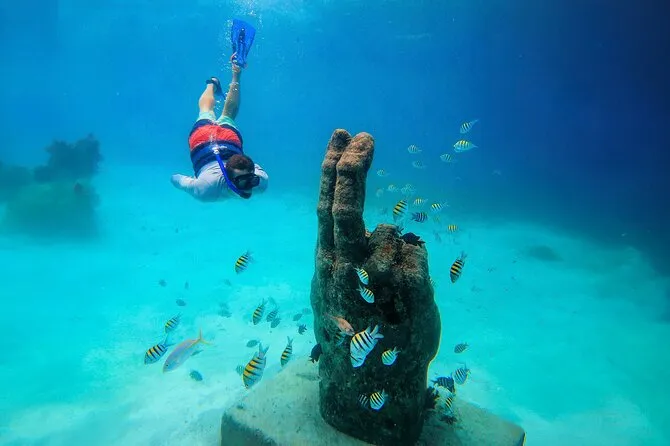
The default, and for most visitors the right call. Snorkel tours from Cancun work the Nizuc gallery or float the Manchones site as part of a longer day, and no certification or experience beyond basic swimming is needed. The 5-in-1 tour stacks the statues with the reef, a shipwreck, turtle grass beds and a cenote in one 7-hour day for $79, which is the most MUSA-per-dollar structure in our comparison.
Its shorter sibling, the reef and shipwreck trip, runs the same price with hotel pickup folded in.
Scuba Diving
Certified divers get Manchones at eye level. Two-tank museum-plus-reef dives run around $159 with equipment and the marine park fee included, minimum age about 10, certification card required in plastic, digital or photo form. Standard dive rules apply and matter here because most visitors fly home soon after: leave 18 to 24 hours between your last dive and your flight.
Operators in the park also refuse divers with certain medical conditions and anyone pregnant, so read the waiver before you book the slot, not after.
Glass-Bottom Boat
If nobody in your group wants to get wet, glass-bottom boats run over the Punta Nizuc gallery for about $58 USD per person, or $78 USD packaged with a snorkel stop, per the operator price boards checked August 2026. In 4 meters of clear water the statues read surprisingly well through the hull. It is the only MUSA option for non-swimmers, small children and anyone who cannot equalize, and it is also the version to pick on a windy day when surface chop would make snorkeling miserable.
How to Get to MUSA
There Is No Front Door
MUSA has no pier, no ticket office and no way to visit independently; every legal visit goes through a licensed operator inside the marine park. That makes how do I get there really a question of which departure point suits your hotel. For Salon Nizuc, boats leave from marinas at the southern end of the Cancun Hotel Zone along Boulevard Kukulcán, a short ride from any Hotel Zone address.
For Salon Manchones, departures split between Hotel Zone marinas around kilometer 4 of Kukulcán, Puerto Juárez north of downtown, and Isla Mujeres itself, which sits closest to the gallery.
From Cancun, Isla Mujeres and the Riviera Maya
From the Hotel Zone, a Nizuc snorkel trip is a 10 to 25 minute boat ride depending on your marina. Manchones trips from Cancun cross the bay in 30 to 45 minutes, and the Isla Mujeres catamaran makes the crossing part of the day, sailing out with an open bar and snorkeling the Manchones area en route. Staying on Isla Mujeres itself puts you 10 minutes from the statues, and local dive shops on Hidalgo street run the site daily.
From Playa del Carmen or Puerto Morelos, add an hour of highway transfer each way; several Cancun tours include Riviera Maya pickup, but check the pickup map before assuming.
What a MUSA Snorkel Trip Actually Looks Like
Take the typical statue-inclusive day as it actually runs. Pickup or marina check-in lands between 8:00 and 9:30 AM, followed by a briefing where the guide covers the two rules that matter: no touching the sculptures, no standing on anything. The boat works its stops in whatever order the wind allows; captains decide on the day, which is why no serious operator promises an exact statue you will see.
At the MUSA stop you get roughly 30 to 40 minutes in the water, floating a marked circuit above the installation while the guide tows a flotation ring for anyone who wants a rest. Water time feels short on paper and is not; surface swimming over a site this dense is tiring, and half an hour covers the gallery. Multi-stop days then move on to reef, wreck or cenote stops and land you back at the marina 5 to 7 hours after the start.
Bring a rash guard instead of sunscreen, cash for the dock fee if your tour lists one, and a phone in a waterproof pouch; the statues sit shallow enough that surface photos genuinely work.
Best Time to Visit: Season and Water Clarity
Season by Season
The dry season from November through April gives the calmest surface and the most reliable visibility, and it is when the statue photos with sunbeams get taken. May through October is warmer, wetter and windier in bursts, but rain usually arrives in the afternoon, so morning departures dodge most of it; this is also the emptier half of the year on the boats. Regional visibility runs 24 to 35 meters on good days, far more than the 4 to 8 meters of depth you need to see either gallery, so an average day here still counts as excellent almost anywhere else.
Our homepage charts the month-by-month visibility picture season by season.
Photographing the Statues
The classic MUSA shot is taken looking down through the surface with the sun behind you, so late morning, roughly 10 AM to noon, gives the cleanest light at both galleries. At Nizuc a basic phone in a waterproof pouch produces real results because the subjects sit only 4 meters down; at Manchones a duck dive to 2 or 3 meters tightens the frame dramatically. Skip the flash, it only lights particles in the water, and shoot wide rather than zoomed.
Divers with strobes should ask the guide to point out The Silent Evolution's outer rows, where single figures stand clear of the crowd and make better portraits than the dense center.
Time of Day and Weather Calls
Book the morning slot. Wind builds through the afternoon on this coast, and Nizuc especially sits in open water where chop kills both comfort and photos. September and October bring the highest chance of port closures; operators cancel and rebook when the harbormaster closes the bay, which is a reason to schedule MUSA early in your trip rather than the last morning, and to prefer tours with free cancellation, which all three trips listed above carry.
Rules, Fees and Etiquette in the Marine Park
MUSA sits inside a national marine park, and the park's rules ride along with every trip. The non-negotiables:
- No touching, standing on or holding the sculptures; the cement surface is a growing coral substrate, and a hand print can wipe out a season of settlement
- Regular sunscreen is prohibited in the water; operators expect a rash guard or nothing, and several turn away visibly creamed guests until they rinse
- Life vests or flotation belts are standard issue on snorkel trips inside the park; expect to wear one
- The marine park fee is bundled or collected by your operator, typically included in dive pricing and either included or collected as a small cash dock fee on snorkel trips; read the listing's inclusions line
- No fishing, no drones over the boat traffic zones without a permit, and no unlicensed boats; a cheap beach-tout offer to run you out to the statues is both illegal and uninsured
MUSA or the Natural Reef? Honestly, Do Both
MUSA is a spectacle, but it is a sculpture garden, not an ecosystem in full swing, and first-time snorkelers who only see statues miss what the Mexican Caribbean actually does best. The strongest natural snorkeling near Cancun sits 35 minutes south inside Puerto Morelos Reef National Park, where the Mesoamerican Barrier Reef passes 500 meters off the beach and turtle and ray sightings are routine. The clean way to structure a trip: one day on the statues, one morning on the Puerto Morelos reef with a small-group boat.
If you only have one day, the 5-in-1 itinerary is the compromise that covers statues, natural reef and a shipwreck in the same seven hours. Every option, with live prices and honest trade-offs, sits in our full comparison of Cancun snorkeling tours.
Where MUSA's Galleries Sit
The two galleries are 18 kilometers apart, which is why no single stop shows you all of MUSA. Pins mark the installation areas; exact mooring points shift with conditions.
MUSA Cancun: Questions People Actually Ask
What is MUSA, Mexico?
MUSA is the Museo Subacuático de Arte, an underwater museum of more than 500 life-size sculptures installed on the seabed of the Cancun marine park between Cancun and Isla Mujeres. It was created from 2009 by sculptor Jason deCaires Taylor with Mexico's marine park authority to draw visitor traffic away from stressed natural coral, and opened formally on November 26, 2010. The sculptures are built from pH-neutral cement and are slowly becoming an artificial reef.
Is MUSA Cancun worth it?
For most visitors, yes, with one caveat. Floating over a 400-figure stone crowd is unlike anything else in the Caribbean, and the shallow depths mean even weak swimmers see it well. The caveat is that MUSA is art, not marine life; if you can only do one water day and want fish and turtles, the natural reef at Puerto Morelos delivers more biology. The best answer is a combined day like the 5-in-1 tour, which does statues and natural reef in one trip.
How deep is MUSA Cancun?
It depends on the gallery. Salon Nizuc, off Punta Nizuc, sits in roughly 4 meters, about 13 feet, of water and is limited to snorkelers and glass-bottom boats. Salon Manchones, off Isla Mujeres, sits at roughly 8 meters, about 26 feet, and takes both scuba divers and snorkelers. Neither is deep by diving standards, which is why the site works for beginners.
How do I get to MUSA Cancun?
You cannot reach MUSA on your own; there is no shore access and all visits run through licensed boats inside the marine park. Snorkel trips to the Nizuc gallery leave from marinas at the south end of the Cancun Hotel Zone, while Manchones trips depart from Hotel Zone marinas, Puerto Juárez or Isla Mujeres. Booking a tour is the transport; the catamaran option even folds the Isla Mujeres crossing into the day.
How much are MUSA Cancun tickets?
There is no standalone MUSA ticket; the price of the boat trip is the price of the museum. In our comparison, snorkel days that include the statues run $79, glass-bottom boat passes over Salon Nizuc cost about $58 USD, and two-tank dives at Manchones with the museum included run around $159 with gear and the park fee, all checked August 2026.
How much does it cost to go snorkeling in Cancun?
Across the eight tours in our Cancun snorkeling comparison, prices run from $39 for a 4-hour reef trip with lunch to $79 for full 7-hour multi-stop days, with the certified-diver reef option at $159. Budget a little extra for the marine park dock fee where a listing collects it in cash, and for photos, which most operators sell separately.
Can you snorkel MUSA without a diving certification?
Yes. Snorkeling requires no certification at either gallery, and Salon Nizuc exists specifically for surface visitors; scuba is not even permitted there. You should be comfortable swimming in open water for about half an hour, and guides bring flotation rings for anyone who wants a break. Only the 8-meter Manchones dives require a certification card.
Can you see MUSA without getting in the water?
Yes, by glass-bottom boat over the Salon Nizuc gallery, about $58 USD per person as of August 2026. The statues sit only 4 meters down in clear water, so they read well through the hull. It is the standard choice for non-swimmers, toddlers and rough-day rebookings.
When is the best time to visit MUSA?
November through April brings the calmest seas and clearest water, and mornings beat afternoons year-round because wind builds after midday. May through October works fine with a morning departure and thinner crowds, though September and October carry the highest chance of a weather cancellation, so schedule MUSA early in your trip and book something with free cancellation.
MUSA gets described as a bucket-list oddity, and that undersells it. It is a working conservation project you are allowed to float through, a crowd of real Puerto Morelos faces slowly turning to coral 8 meters under the boat lanes. See it while the faces are still faces.