Puerto Morelos Snorkeling: Inside the Reef National Park
Puerto Morelos snorkeling happens inside a national park: the Mesoamerican Barrier Reef passes roughly 500 meters off the town beach, close enough that the surf break is visible from the sand, and the whole stretch has been protected as Parque Nacional Arrecife de Puerto Morelos since 1998. That protection is exactly why the snorkeling here beats the Hotel Zone, and also why you cannot just swim out to it. This page covers how access really works, what the trips cost, when the water is at its best, and how the town's boats compare with tours that start in Cancun.
Quick answer
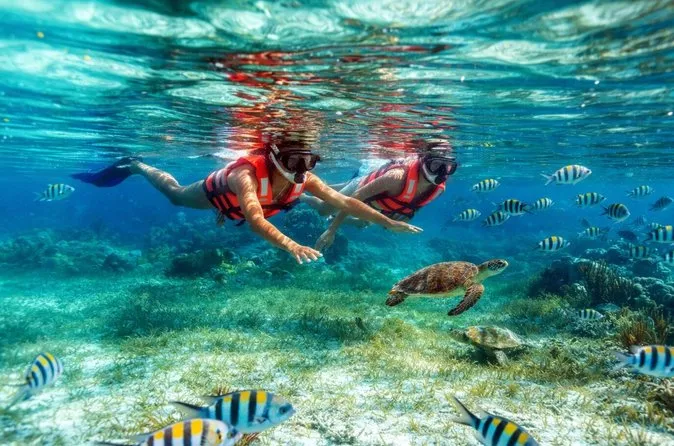
The Puerto Morelos Reef National Park protects about 9,000 hectares of the Mesoamerican Barrier Reef, starting roughly 500 meters off the beach of a small port town 36 kilometers south of Cancun. Swimming out from shore is prohibited; every visit goes by licensed boat with a guide and a life vest, in trips of about 2 to 4 hours with two reef stops. Turtles, rays and parrotfish are routine sightings, visibility runs 24 to 35 meters, and the calmest, clearest months are November through April.
Key takeaways
- Boat-only access: the shore swim to the reef is banned, both for safety and for the coral, so a guided trip is the entry ticket
- The two-stop small-group reef trip runs $45 for 3 hours with a maximum of 10 guests; the 4-hour version with beachside lunch is $39
- Budget up to $15 USD, roughly 280 Mexican pesos, extra in cash for the marine park and dock fees where a tour collects them separately (checked August 2026)
- Mandatory in the park: life vest on, biodegradable sunscreen at most, and ideally none, wear a rash guard instead
- The reef here is natural coral at full strength; for the statue version of Cancun snorkeling, that is the MUSA underwater museum
Puerto Morelos Reef Trips We Compare
Five of the eight tours in our comparison work the Puerto Morelos park. These three are the purest reef trips; prices and reviews come from the operators' live Viator listings.
from $39
Reef Snorkeling in Cancun National Park with Beachside Lunch
Snorkel the Great Maya Reef inside Puerto Morelos National Park — a UNESCO Biosphere Reserve — with a certified guide, then relax with a beachside lunch included. Spot…
- UNESCO Biosphere Reserve reef
- Certified guide included
- Beachside lunch included
- Half-day — back by noon
 from $45
Small-Group Mesoamerican Barrier Reef Snorkeling, Puerto Morelos
Skip the long lines and snorkel the Mesoamerican Barrier Reef — the second-longest coral reef in the world — with a guide in a small group limited to…
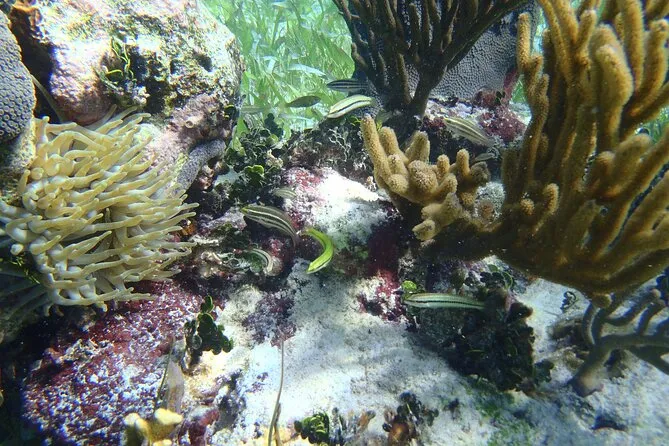
- Mesoamerican Barrier Reef
- Skip-the-line access
- Small group max 10
- Eagle rays, lobster & fish
 from $43
Private Small-Group Snorkel Guide in Puerto Morelos (Max 10 Guests)
Waste no time snorkeling in the wrong places — swim out with an expert local guide at Puerto Morelos reef in a group capped at just 10 people…
- Perfect 5.0★ — 381 reviews
- Small group, max 10 guests
- Expert local guide
- No crowded boat needed
What Makes This Reef a National Park
The Protected Stretch of the Mesoamerican Reef
The reef off Puerto Morelos is part of the Mesoamerican Barrier Reef, the second-largest barrier reef system in the world, running from the Yucatán down to Honduras. In 1998 Mexico declared this section a national park, Parque Nacional Arrecife de Puerto Morelos, protecting around 9,000 hectares of coastal water between the beach and the open Caribbean. The listing matters in the water: because fishing and anchoring are controlled and visitor numbers are managed through licensed boats, the coral here still carries dense stands of elkhorn and staghorn, species that have thinned badly elsewhere on this coast, alongside brain corals and sea fans.
Puerto Morelos Reef at a Glance
Figures below are drawn from park information and operator listings, checked August 2026.
| Detail | Puerto Morelos Reef National Park |
|---|---|
| Protected since | 1998 |
| Protected area | About 9,000 hectares of coastal water |
| Distance from beach | Roughly 400 to 550 meters, depending on the section |
| Snorkel depth | Mostly 2 to 8 meters over the reef crest and gardens |
| Water temperature | 24 to 29°C (75 to 84°F) year-round |
| Visibility | 24 to 35 meters (80 to 115 feet) on average |
| Access | Licensed boats with guides only; no shore swimming to the reef |
| Typical trip | 2 to 4 hours, two snorkel stops |
The distance from shore is quoted differently by different sources, 400 meters in some write-ups and 500 or more in others; the honest answer is that the reef is a long band, not a point, and the gap varies along the beach. What no source disputes: it is close. From the town pier you can see the white line of surf breaking on the reef crest, and boat rides to the first buoy take about 10 minutes.
Why You Cannot Swim Out From the Beach
For years, strong swimmers crossed the lagoon from the beach to the reef on their own. The park has ended that: swimming out to the reef from shore is no longer allowed, and the rule is enforced at the buoy line. Two reasons drive it.
Safety first, since 400-plus meters of open water each way with boat traffic in between is further than it looks from the sand. Coral second, since unguided snorkelers stand up on whatever is under their fins, and the shallow reef crest is exactly where the endangered elkhorn grows. In practice the rule costs you little: cooperative boats leave the town pier all morning, the ride is minutes long, and a guide who knows where yesterday's turtle was feeding finds you more life in an hour than a solo swim would in three.
What remains free is the lagoon itself; you can swim and wade off the town beach, and you will see the odd fish over the seagrass, just not the reef.
Cooperative Boats vs. Cancun-Based Tours
Booking at the Pier
Puerto Morelos runs on fishing cooperatives whose members now carry snorkelers as much as catch. Their lanchas leave from the pier by the town square, run about 2 hours with two reef stops, and include the guide, vest and gear. Walking up works on quiet mornings; in the December to April high season, the day's slots can be gone by 10 AM.
Quality is generally good and the money stays in town, but boats are open pangas with no shade, no bathroom and cash-first pricing, and English levels vary from fluent to gestures.
Booking a Tour From Cancun
The tours in our comparison bottle the same reef into a more predictable package: fixed departure times, online booking with free cancellation, guaranteed English-speaking guides, and in some cases hotel pickup from Cancun or the Riviera Maya. The $39 reef trip with beachside lunch turns the morning into a half-day with a meal; the max-10 small-group boat at $45 is the closest thing to a private cooperative trip you can reserve in advance, and the genuinely private option runs $43 per person for up to 10 guests. The trade-off is simple: booking ahead costs a few dollars more than the pier and removes every variable except the weather.
Which to Choose
Staying in Puerto Morelos with flexible days? Use the pier, go early, bring pesos. Coming down from Cancun for the morning, traveling with kids, or working around a flight?
Book ahead; a confirmed slot beats standing at the pier at 9 AM finding out the cooperatives are full. Certified divers have a third path, the $159 two-tank dive on the same park's deeper walls.
What It Costs, Fee by Fee
Prices below are from live operator listings and traveler-verified reports, checked August 2026.
| Item | Price | Notes |
|---|---|---|
| Two-stop reef snorkel, small group | $45 USD | About 3 hours, max 10 guests, gear included |
| Reef snorkel with beachside lunch | $39 USD | About 4 hours from Cancun, lunch included |
| Early two-stop biosphere trip | $45 USD | 2.5 hours, 8 AM start beats the crowds |
| Private small-group boat | $43 USD per person | Your own guide and boat, up to 10 guests |
| Two-tank certified dive | $159 USD | Deeper park walls, certification card required |
| Marine park / dock fees | Up to $15 USD (about 280 pesos) cash | Included on some tours, collected separately on others |
The fee line is the one that catches people. Some operators fold the national park bracelet and dock charges into the headline price; others, including several catamaran and whale-shark trips along this coast, collect around $15 USD per person in cash on the day. Neither approach is a scam, but read the inclusions list before you board so the pesos are in your pocket, not back at the hotel.
Turtles, Rays and What Else You Will Actually See
The Regulars
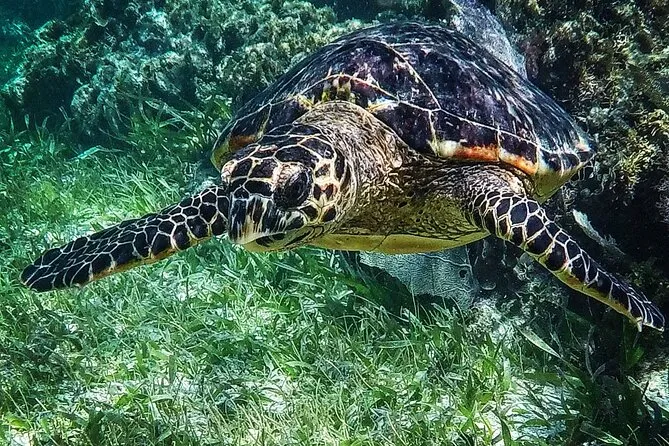
This is a working reef, and the cast list is long. Green and loggerhead turtles graze the seagrass between the beach and the reef, and guides who run the park daily know the feeding patches, which is why turtle sightings on guided trips are routine rather than lucky. Southern stingrays cruise the sand channels, spotted eagle rays pass along the outer edge, and the coral itself holds parrotfish, blue tangs, angelfish, French grunts, barracuda hanging motionless in the current, moray eels in the crevices and the occasional porcupinefish.
Small nurse and reef sharks turn up now and then; they are curious and harmless.
What You Will Not See
Manage two expectations. First, this is not an aquarium drift over a wall; the snorkel zones are shallow gardens and crests, so the drama is density and color rather than depth. Second, whale sharks are a separate trip entirely; they gather far offshore between roughly May and September and are visited on dedicated full-day tours, not on reef snorkels.
If a beach seller promises whale sharks on a two-hour reef trip, walk away.
Best Months for the Clearest Water
Dry Season, November Through April
The dry season is the sure bet: light rain, gentle seas, and the visibility end of that 24 to 35 meter range. Water temperature bottoms out around 24 to 26°C, warm enough that most snorkelers skip wetsuits, and the trade winds are at their calmest in the morning windows the boats use. The cost is company; this is high season, and pier slots and small-group tours sell out days ahead around Christmas, February and Easter week.
Wet Season, May Through October
Summer runs warmer, 27 to 29°C in the water, with rain that mostly arrives as afternoon downpours, so 8 and 9 AM departures stay dry more often than not. Boats are emptier and prices at the pier soften. The two watch-outs are wind and sargassum: September and October bring the most weather cancellations, and seaweed arrivals vary year to year and week to week; the reef itself sits outside the wrack line, but heavy sargassum can make beach entries and the lagoon less pleasant.
The season-by-season picture for the whole coast is charted on our Cancun snorkeling homepage.
Park Rules You Will Be Asked to Follow
The park's rules are enforced by the guides, not posted and forgotten. Expect all of these on any legal trip:
- Life vest or flotation belt worn in the water, no exceptions, even for strong swimmers; it keeps snorkelers horizontal and off the coral
- No sunscreen unless it is genuinely biodegradable, and guides prefer none at all; a long-sleeve rash guard solves the problem better than any lotion
- No touching or standing on coral, no gloves, and no collecting anything, shells included
- No feeding fish and no chasing turtles; give them 2 to 3 meters and they will ignore you and keep grazing
- Stay with your guide and inside the buoyed snorkel zones; the park limits group sizes per guide, which is why boats feel small
- No fishing, no anchoring on reef, and no drones over the park without a permit
The Town Behind the Pier
Puerto Morelos itself is half the reason to do the reef here rather than from a Cancun marina. It is a real port town of modest size wedged between Cancun and Playa del Carmen, built around a sandy square, a malecón, and the leaning lighthouse, knocked crooked by a hurricane in 1967 and left standing as the town's emblem beside its upright replacement. Mornings around the square are fishermen, coffee and snorkel groups; evenings are seafood at places along the beachfront, with El Pesquero and the taco stands off the square doing the volume.
The town also sits at the mouth of the Ruta de los Cenotes, the inland road lined with sinkholes; Ojo de Agua, about 30 minutes inland, charges around $15 USD, roughly 280 pesos, and makes an easy same-day pairing with a morning reef trip. If the itinerary allows it, snorkel at 9, eat ceviche at noon, swim a cenote at 3.
How a Morning on the Reef Actually Runs
A typical two-stop trip, whether from the pier or pre-booked, follows the same arc. You meet between 8:00 and 10:00 AM, sign the park paperwork, and get fitted for mask, fins and vest; earlier departures get glassier water and first pick of the snorkel zones. The boat ride out is about 10 minutes.
Stop one is usually a shallow coral garden in 2 to 4 meters, 35 to 45 minutes in the water with the guide leading a slow loop and pointing out what the group would otherwise miss. Back on board for water and a move to stop two, often a deeper crest section toward 5 to 8 meters where the rays and bigger barracuda hold. Another 30 to 40 minutes, then the ride home, feet on the pier around two and a half hours after you left it.
Bring cash for fees and tips, a rash guard, and a towel; leave the sunscreen at the hotel. Guides work partly for tips here, and 50 to 100 pesos, about $3 to $6 USD, per snorkeler is a normal thank-you for a good one. If seasickness worries you, this is one of the gentlest boat trips on the coast: short rides, calm lagoon water on the inside leg, and most of the time spent floating rather than motoring.
Puerto Morelos, MUSA or the Hotel Zone?
Three different products share the phrase Cancun snorkeling. The Hotel Zone's own beaches are for swimming, not snorkeling; the sand bottom holds little. The MUSA underwater museum is a spectacle, 500-plus sculptures in 4 to 8 meters of water, art first and fish second.
Puerto Morelos is the biology: the healthiest accessible stretch of natural reef on this part of the coast, with the turtles and rays to match. Ideally you give the trip one day of statues and one morning of reef. With a single free morning and a wish for the greatest variety per hour, the multi-stop days on our tour comparison split the difference, several of them touching both the park and the sculpture sites in one run.
Where the Park and the Reef Sit
The reef runs as a band parallel to the beach; pins mark the town pier where boats depart and the central snorkel zone. Guides pick the day's exact stops by wind and swell.
Puerto Morelos Snorkeling: Frequently Asked Questions
Is snorkeling good in Puerto Morelos?
Yes, and by most measures it is the best natural-reef snorkeling in the Cancun area. The Mesoamerican Barrier Reef passes about 500 meters off the beach inside a national park protected since 1998, so the coral is dense, visibility averages 24 to 35 meters, and turtle and ray sightings on guided trips are routine. The small-group two-stop trip is the format most visitors should start with.
How much does it cost to snorkel in Puerto Morelos?
Guided two-stop reef trips in our comparison run $39 to $45 USD per person for 2.5 to 4 hours, with a private small-group boat at $43 per person and a certified two-tank dive at $159, all checked August 2026. Where a tour does not include the marine park and dock fees, budget up to $15 USD, about 280 pesos, extra in cash. The full price rundown of all eight Cancun tours is on our homepage.
Can you swim in the ocean at Puerto Morelos?
Yes. The town beach and the lagoon inside the reef are calm, shallow and open for swimming, which is exactly what the reef barrier does for the shoreline. What you cannot do is keep swimming out to the reef itself; the crossing is prohibited, and the reef is visited only by licensed boat with a guide.
Can you snorkel from shore in Puerto Morelos?
Not on the reef. The old shore swim out to the coral is banned for safety and reef-protection reasons, and the rule is enforced at the buoy line. From the beach you can snorkel the seagrass lagoon and see the occasional ray or school of grunts, but the coral, turtles and big fish are on the boat trips.
Is it worth going to Puerto Morelos?
For snorkelers, clearly yes: 35 minutes from Cancun buys you a protected reef, small boats instead of party catamarans, and a genuine town with a square, a fishing pier and a famously crooked lighthouse. Even non-snorkeling companions get a good morning out of the beach, the malecón and lunch. It pairs naturally with a cenote on the Ruta de los Cenotes the same afternoon.
What is the best month for Puerto Morelos snorkeling?
November through April gives the calmest seas, the clearest water and the most reliable conditions, at the cost of high-season crowds around Christmas and Easter. May through October is warmer and quieter with afternoon rain that morning trips dodge; September and October carry the highest cancellation risk. Whale sharks, a separate offshore trip, run roughly May to September.
Will I see turtles snorkeling in Puerto Morelos?
Very likely on a guided trip. Green and loggerhead turtles feed on the seagrass beds inside the park, and guides who run the reef daily know the current grazing patches. No honest operator guarantees wildlife, but turtles are among the most consistent sightings here, along with southern stingrays, parrotfish and barracuda. The 4-hour trip with lunch leaves plenty of water time to find them.
Is the marine park fee included in tour prices?
It depends on the operator. Several trips in our comparison bundle the park bracelet and dock fees into the listed price; others collect around $15 USD, roughly 280 pesos, per person in cash on the day. The inclusions list on each tour page states which way it works, so check it before you travel and carry small bills either way.
Is Puerto Morelos snorkeling suitable for beginners and kids?
Yes, it is one of the friendliest open-water snorkel settings on this coast. The lagoon side of the reef is calm and shallow, life vests are mandatory anyway, guide-to-guest ratios are capped by the park, and guides carry flotation rings. Children who can swim confidently do fine on the standard trips; families often prefer the private boat option, which sets its own pace.
How does Puerto Morelos compare to MUSA?
They answer different wishes. Puerto Morelos is living reef, the place for coral, turtles and fish density. MUSA is an underwater sculpture museum, more than 500 statues in 4 to 8 meters of water, extraordinary as art but thinner on marine life. With two mornings available, do both; with one, pick fish or statues honestly, or take a multi-stop day that touches each.
The short version: get to the pier or the pickup point early, wear the vest without complaint, skip the sunscreen, and let a local guide steer you to where the turtles were yesterday. Puerto Morelos rewards exactly the kind of snorkeler who reads a page like this before going.