What to Wear and Bring Snorkeling in Cancun

What to wear snorkeling in Cancun, and what to bring with you, comes down to one surprise most first-timers miss: several Puerto Morelos boats will not let you board with sunscreen at all, reef-safe or not. Once you know that, the rest of the list is short, because guided Cancun snorkeling tours that supply the gear already carry masks, fins and life jackets. What's left is a handful of things worth packing yourself, and a couple of habits worth changing before you land.
Quick answer
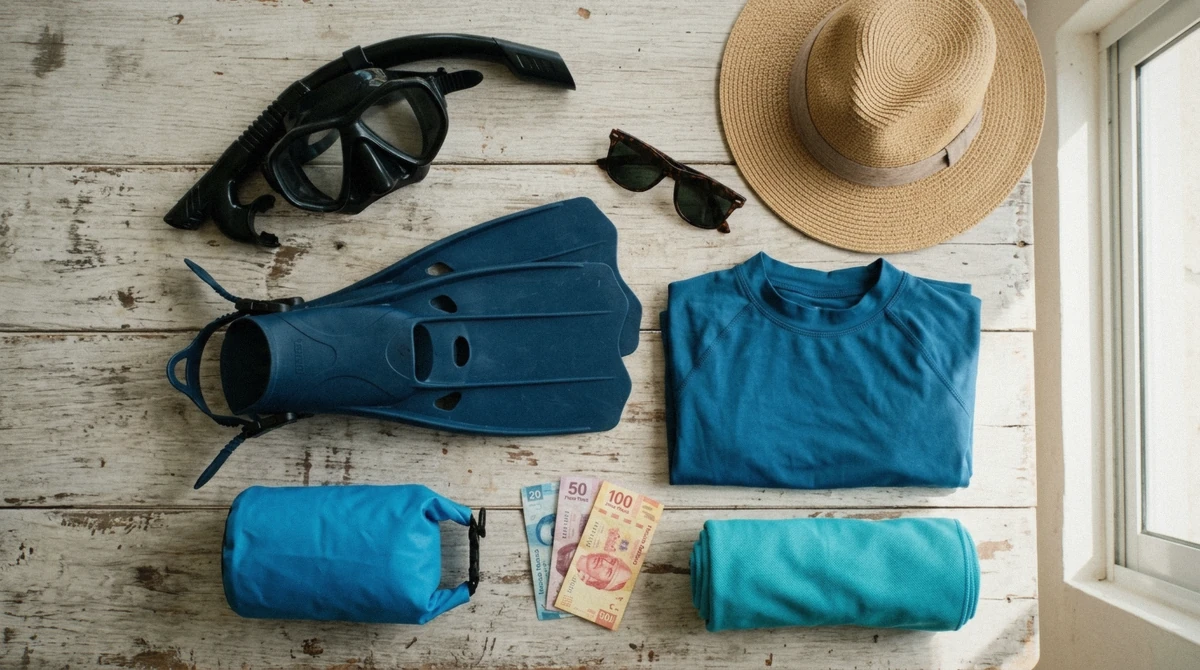
Tours supply the mask, fins and life jacket, so pack a rash guard instead of sunscreen, water shoes, a dry bag, cash in pesos and a change of clothes. Most Puerto Morelos boats ban sunscreen outright at check-in, not just non-reef-safe brands, and no wetsuit is needed in water that stays 26-29°C year-round.
Key takeaways
- Gear is covered: the $45 Puerto Morelos barrier reef trip hands you mask, fins and a life jacket at the dock
- Sunscreen is the one item to leave at the hotel; a rash guard is what actually gets you on the boat
- Skip the wetsuit: sea temperature never drops below the mid-20s, so a rash guard is the only cover you need
- Footwear answer in one line: water shoes for rocky entries, sneakers for the boat deck, never flip-flops in the water
- Cash in pesos covers tips and the dock fee: cards don't work at most piers
- Packing barely changes by season: there's no cold water to plan around, the swings are in rain and sargassum instead
What to Wear
Base Layer: Swimwear
Wear your swimsuit under your clothes to the dock. A one-piece or snug board shorts under a rash guard ride better under a life jacket for two to three hours than loose trunks, which tend to ride up once the vest is cinched. Quick-dry synthetic fabric beats cotton for the same reason it always does on the water: cotton stays wet, holds the chill on a breezy boat ride back, and chafes against the vest straps by the second stop.
Sun Protection: The Rule Most Guides Get Wrong
Here is the detail almost every packing list gets wrong. The common advice online is "bring reef-safe sunscreen." In Puerto Morelos, several established operators go further and ban sunscreen at the boat entirely, reef-safe or not. Wet Set's own site states no sunscreen or lotions are allowed on board; Absolute Adventure calls it forbidden, even biodegradable brands; Dive Puerto Morelos's Spanish-language policy says the same.
The legal basis is real but narrower than people assume: the park's management rules prohibit "non-biodegradable" sunscreen, a park regulation, not a Mexican federal or state law naming oxybenzone or octinoxate specifically. In practice none of that matters at check-in, because the operators simply say no bottles of any kind. A rash guard with UPF fabric is the practical substitute, which is exactly why several boats hand out free wetsuits or rash guards for exactly this reason.
Cover your shoulders and back with fabric, apply any sunscreen only hours before you leave the hotel so it has time to absorb, and reapply on land after the tour, never on the boat.
Wetsuit: When You Might Want One
You will not need one for warmth at any time of year. Sea temperature off Puerto Morelos and the Cancun reefs runs roughly 26-29.5°C across the calendar, and standard guidance for water that warm is a rash guard or boardshorts, no wetsuit, no booties. Some operators still hand out a thin wetsuit anyway, mainly as sun cover rather than insulation, since it does the same job as a rash guard without you having to pack one.
If you run cold easily or you're doing back-to-back stops for two-plus hours, ask your guide whether a wetsuit is available; it costs nothing extra on the tours that stock them and there's no shame in wanting one even in 28°C water.
Footwear
Water shoes or reef booties are the default answer for most of this coast: they grip on the wet dock ladder, protect against the odd sea urchin near rocky entries, and stay on your feet in the surf where a sandal would not. Sneakers are fine for walking to the boat and standing on deck, but take them off before you're in the water, wet closed-toe shoes are heavier and slower once you're actually swimming. Sandals with a secured back strap are fine for lounging at the beach club before or after, never for the activity itself, they slip off the moment you kick.
Barefoot works for soft sand entries only, and even then watch for shell fragments near the tideline. Flip-flops and any unsecured sandal are the one footwear choice to leave at the hotel: they come off in current, they cut feet on rock, and a lost flip-flop in open water is not coming back.
A quick reference for what to actually put on, dock day:
| Color | Good? | Why |
|---|---|---|
| White | context-dependent | reflects heat well on the boat, but goes see-through wet: layer a rash guard underneath, not over a bare swimsuit |
| Black or dark navy | avoid where possible | absorbs heat standing on a sun-baked dock before departure; fine once you're actually in the water |
| Bright orange, yellow, neon | good | the color your guide and boat crew spot first if the group spreads out over open water |
| Muted blues and greens | fine | no functional downside in water: this isn't a wildlife-shyness situation like a land safari |
| Cotton fabric | avoid | stays soaked for hours, chafes under a life jacket strap, and adds a chill on the ride back |
| Quick-dry synthetic | good | the material every rash guard and board short is actually made from, and it dries between stops |
| Rash guard in any color | good | the substitute for banned sunscreen at the boat: color matters less than simply wearing one |
What to Bring
The short list, each item earning its spot in the bag:
- Rash guard: the substitute for sunscreen the boat won't let you bring
- Water shoes or reef booties: rocky entries and the dock ladder
- Dry bag: keeps your phone dry on an open boat
- Cash in small pesos: tips and the dock fee, cards rarely work at the pier
- Refillable water bottle: hours in the sun with no shade on deck
- Change of clothes: you will be salty and wet for the ride back
- Towel: some tours provide one, most don't; pack your own to be safe
- Hat with a chin strap or clip: an unsecured hat is gone in the boat's wake
- Sunglasses with a strap: same problem, worse if they're prescription
- Waterproof phone case or housing: for shots at the surface between stops
- Backup contacts or a glasses strap: see the section below before you pack either
- Motion-sickness tablet, taken before you leave the dock, not after you feel it
What Cancun Snorkeling Tours Provide (So You Don't Overpack)
Inclusions genuinely vary operator to operator: this is drawn from what Puerto Morelos boats actually list, not a generic assumption:
| Item | Usually Provided | Bring Your Own | Notes |
|---|---|---|---|
| Mask, snorkel, fins | Yes | - | Standard on every operator we checked |
| Life jacket | Yes, mandatory | - | Required by Puerto Morelos park rule, not optional gear |
| Wetsuit | Sometimes, free | Only if you prefer your own fit | Offered mainly as sun cover, not for warmth |
| Marine park fee | Varies by operator | Confirm at booking | Some tours fold it in; others collect it cash at the dock |
| Snacks and bottled water | Sometimes | A refillable bottle is worth carrying anyway | The $45 barrier reef tour runs a shorter window, so check before assuming a meal is included |
| Towels | Rarely | Pack your own | One operator we checked is the exception; most are not |
| Freshwater shower | Sometimes, at the dock | - | Worth asking if you'd rather not ride home salty |
| Sunscreen | Never provided, and often banned outright | Leave it at the hotel, wear a rash guard instead | See the sun protection section above |
| Dry storage for phones | Rarely | Bring your own dry bag | - |
| Prescription mask | Never stocked | Order 2-3 weeks ahead | Rental masks are never prescription: see the glasses section below |
| Guide-led private pacing | Only on private bookings | - | The private small-group tour sets its own schedule if you want more time at each stop |
What NOT to Wear or Bring
Sourced from what operators actually turn away at the dock, not generic travel-blog advice:
- Sunscreen of any kind: several Puerto Morelos operators ban it outright at check-in, not just non-reef-safe brands
- Gloves and dive knives while snorkeling: banned under the park's own rules
- Anything you'd mind losing: rings, watches and jewelry come off easily in current and rarely come back
- Glass containers: not permitted on most boats
- Cotton anything: stays wet the whole trip and chafes under a life jacket
- Flip-flops or unsecured sandals: the footwear that slips off in the surf
- Food for the fish: feeding marine life is a banned activity in the park, not a courtesy request
Glasses, Contacts and Prescription Masks
This is worth planning for, not winging. If you wear contacts, take them out before you get in the water. Eye-health guidance is blunt on this: water and contact lenses carry a real risk of Acanthamoeba keratitis, a painful eye infection that is hard to treat and can require a corneal transplant in serious cases. If you're going to snorkel in lenses anyway, use daily disposables and throw them away right after, never reuse a pair that got wet.
For glasses wearers, there are three real routes to a mask you can actually see through. Drop-in lenses are the cheapest option, stock lenses in fixed diopter steps that snap into a standard mask, though they don't correct astigmatism. Inserts or retainers hold your exact prescription inside the mask and are the middle option on both price and fit, though they're a bit fiddlier to clean and can fog more. Bonded lenses are ground to your prescription and permanently fused to the mask's faceplate, the most expensive route but the best for defogging and the only one that handles a bifocal prescription well. Whichever route you pick, order it two to three weeks before your trip. Rental masks at the dock are never prescription, and there's no same-day fix once you're standing at check-in.
Seasickness, Honestly
Most Cancun-area snorkel boats are short open pangas making two or three stops, and for some people that's enough motion to matter. The honest picture, not the wellness-blog version: medication works best taken before you feel anything, not after. The CDC's own travel guidance says motion-sickness drugs are most effective when taken before exposure rather than once symptoms start, and the drugs shown to actually work are scopolamine and sedating antihistamines like dimenhydrinate or meclizine, not the non-drowsy allergy pills most people already have in their bag, those don't do the job here. Scopolamine isn't for everyone; it's contraindicated with glaucoma and some prostate conditions, and it's generally avoided in children.
Ginger and acupressure bands are worth naming honestly too, since they get recommended constantly: the same CDC guidance calls the evidence for both weak and contradictory, not proven, not useless, just unproven. If you want a free backup, sit toward the middle of the boat, keep your eyes on the horizon rather than your phone, skip a heavy or spicy breakfast, and get fresh air rather than ducking under a cabin roof.
Cash for Tips and the Dock Fee
Bring pesos, not dollars, and bring them in small bills. Group tours run smoothly on roughly 100 pesos per person for the guide, private tours run closer to 10-20% of the tour price. Some boats also collect a small dock or conservation fee in cash at check-in rather than folding it into the online price, so having a stack of small notes avoids an awkward wait while someone finds change.
Cards are rarely accepted pierside in Puerto Morelos, and the currency exchange at your hotel is a worse rate than an ATM in town.
What to Leave at the Hotel
A short list of things that only slow you down: any sunscreen bottle, since it likely won't make it past check-in anyway; jewelry you'd be upset to lose; a full-size towel if your operator already provides one; long dive fins, which are built for scuba and awkward on a snorkel boat; a paper map or guidebook, since your guide already knows the reef better than any printout; and a big camera bag, a waterproof phone case handles most of what you'll actually want to shoot from the surface.
Frequently Asked Questions
Why do some Puerto Morelos boats ban sunscreen completely instead of just requiring reef-safe brands?
The park rule itself only says "non-biodegradable" sunscreen is prohibited, but several operators have simplified that into a flat no-sunscreen policy at the boat rather than checking labels for every guest. It's a house rule layered on top of a park regulation, not a Mexican law naming any specific chemical. Apply sunscreen at the hotel well before you leave and switch to a rash guard for the boat itself.
Can I wear my daily contact lenses snorkeling in Cancun?
You can, but take them out before entering the water where possible, since water carries organisms that can cause a serious eye infection in contact wearers. If you do snorkel in lenses, use daily disposables and discard them immediately afterward rather than reusing a pair that got wet.
Do I need to bring my own snorkel mask if I wear glasses?
Only if you want one that fits your prescription. Rental masks at the dock are never prescription, so order a drop-in lens, insert, or bonded prescription mask online two to three weeks ahead. Showing up without one just means snorkeling a little blurry, which most guests find manageable for a short reef tour.
What should I absolutely not pack for a Cancun snorkeling tour?
Sunscreen of any kind heads the list at several Puerto Morelos operators, along with gloves, dive knives, glass containers and anything you'd hate to lose in the water, like loose jewelry.
Is a wetsuit necessary for snorkeling near Cancun?
No. Sea temperature stays roughly 26-29°C year-round, warm enough that standard guidance calls for a rash guard rather than a wetsuit. Some operators still offer one free as sun cover, but it isn't there for warmth.
Do I need seasickness medication for a short snorkel boat trip?
If you're prone to motion sickness on cars or boats, yes, and take it before departure rather than waiting to feel unwell. Sedating antihistamines like dimenhydrinate or meclizine are the options shown to actually work; non-drowsy allergy pills don't treat motion sickness.
Can I wear jeans on a Cancun snorkeling tour?
No. Jeans take a long time to dry, get heavy once wet, and restrict movement getting in and out of the boat. Quick-dry shorts or leggings are the practical choice for the ride there and back.
Can I wear shorts snorkeling in Cancun?
Yes, as swim shorts or board shorts under your rash guard. Quick-dry synthetic material is what you want, not a cotton pair that stays soaked for the whole trip.